

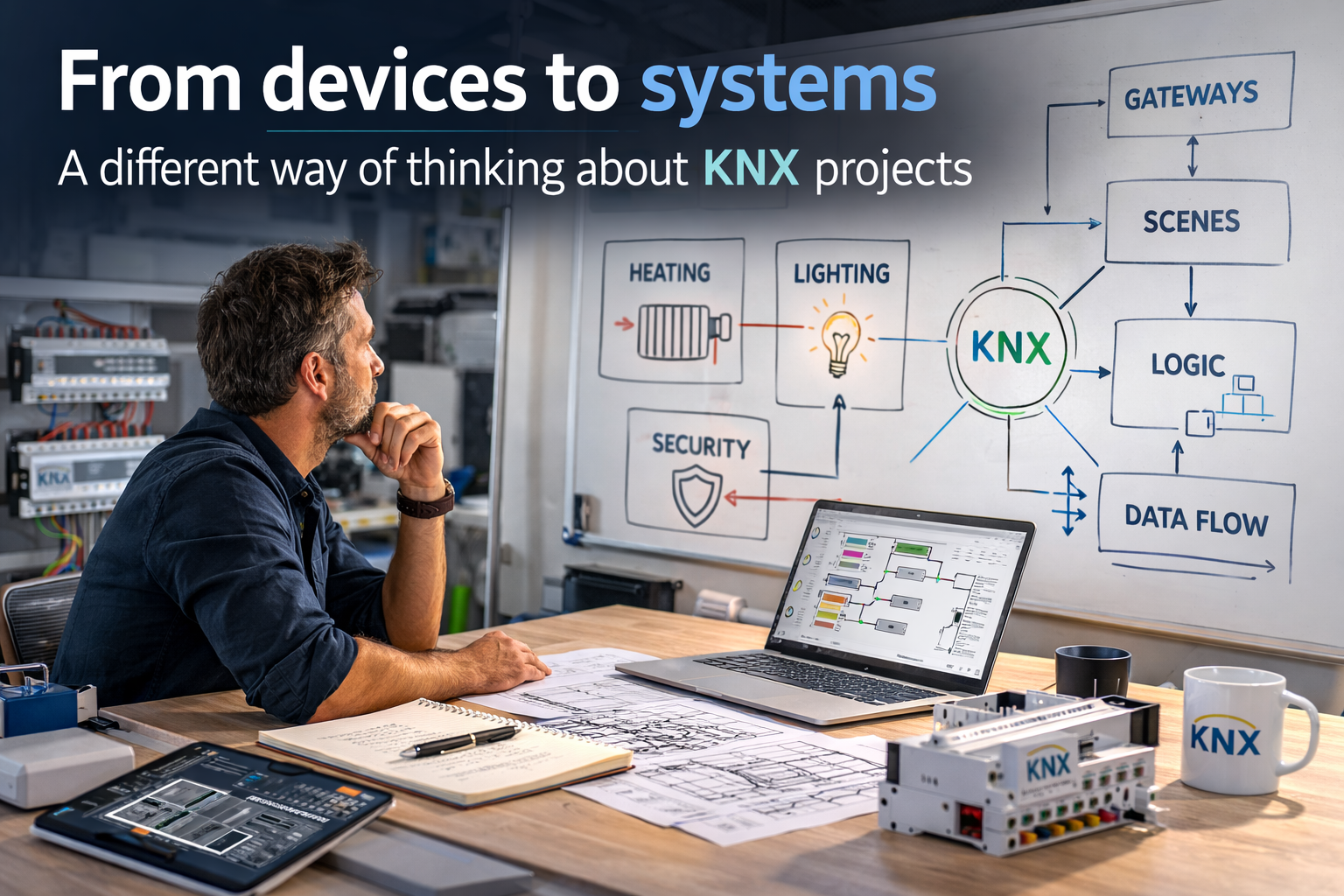
Introduction
Many KNX projects start with devices.
Actuators, sensors, gateways, functions.
Yet the long-term success of a KNX installation rarely depends on individual devices.
It depends on how the system is designed as a whole.
Shifting from a device-centric mindset to a system-oriented approach changes the way projects behave, evolve and remain maintainable over time.
1. Devices are tools, not solutions
Devices perform specific tasks:
- switching
- measuring
- controlling
But they do not define:
- global system behavior
- interaction between subsystems
- long-term stability
When devices are treated as solutions, systems become fragmented.
Architecture disappears, and complexity grows silently.
2. Systems define logic and consistency
A system-oriented approach focuses on:
- architecture
- information flow
- role separation
This ensures that:
- heating, lighting and security behave coherently
- local changes do not break global behavior
- maintenance remains predictable
Consistency is not accidental.
It is designed.
3. Why complexity is often self-inflicted
Many KNX systems become complex not because KNX is complex,
but because design decisions are made incrementally, without a global vision.
Adding devices without architectural rules leads to:
- duplicated logic
- hidden dependencies
- fragile integrations
System thinking reduces complexity by design, not by simplification.
4. System thinking applies to all KNX domains
Whether dealing with:
- heating regulation
- KNX–DALI lighting integration
- remote access and system security
The same principles apply:
- define architecture first
- clarify responsibilities
- design for evolution
Different use cases.
Same reasoning framework.
5. Designing for the future, not just commissioning day
KNX systems are long-term installations.
A system-oriented design ensures that:
- future changes remain predictable
- new functions integrate smoothly
- documentation keeps its value
A system that cannot evolve safely is already a technical debt.
Conclusion
Successful KNX projects are not built device by device.
They are designed as systems.
Moving from device-centric thinking to system-oriented design is the key to:
- reliability
- maintainability
- long-term value
This change of perspective is what separates functional installations from robust systems.
This system-oriented philosophy is the foundation of the available KNX technical guides, which focus on real-world design decisions rather than isolated functions.
